DSW ponding water monitoring

Measures ponding water next to your roof drains, every minute, so you know when a drain stops keeping up. It stands next to the drain on a ballast block, charges from its own solar panel and alerts your team during the storm, while someone can still check a blocked drain.
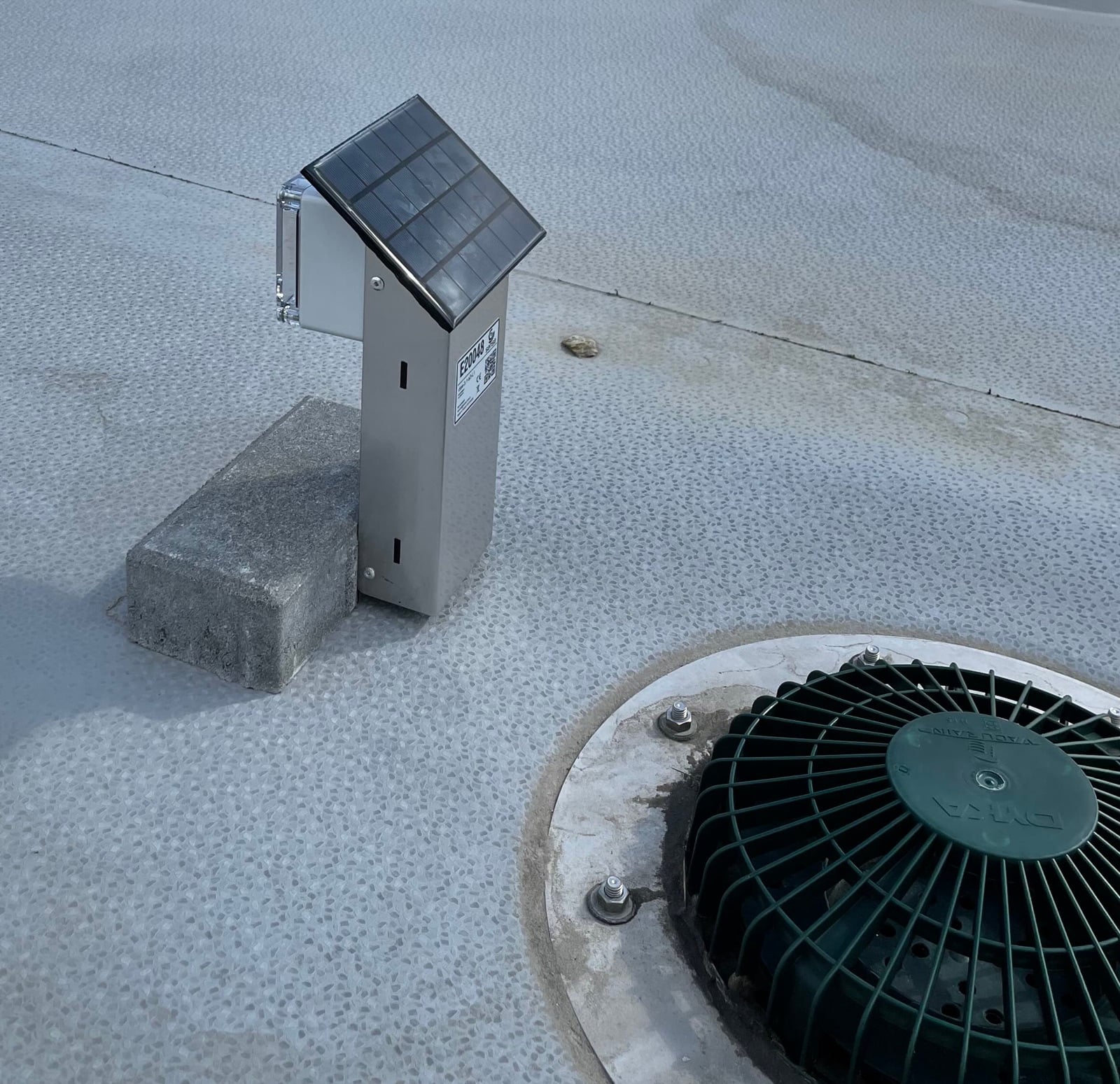
DSW sensor with a small solar panel on a concrete ballast block, next to a roof drain on a flat roof
  • 60 s

    Between readings, 20 s at most in intense rain

  • ±0.2 in

    Accuracy (±5 mm)

  • 0.8–5.9 in

    Water level range (2–15 cm)

Why ponding water matters

The problem

Water builds up on a flat or low-slope roof during heavy rain or when a drain is clogged. Storms are getting more intense and harder to predict, so this happens more often.

Water that stays on the roof adds load to the structure, soaks the insulation and shortens the life of the roof covering. The drains have to work, and someone has to know when they don’t.

How it works

DSW stands next to a roof drain on a concrete ballast block, so installation is non-invasive. It measures the height of the water around the drain.

  • A reading every 60 seconds, and as often as every 20 seconds during intense rain.
  • Each sensor runs on a rechargeable battery charged by its own solar panel. There is no cable to run to any drain.
  • Sensors send readings over LoRaWAN to a DSW gateway on the roof. The gateway passes them to the Smart Roofs Platform through its built-in cellular modem, without using the building’s network.
  • When the water level crosses a predefined threshold, the platform sends SMS and email alerts to your team.
How DSW measures ponding water Section through a roof sloping toward a drain. Water ponds around the drain. DSW stands next to the drain on a ballast block with its solar panel on top and measures the water level. When the water rises above the alert threshold, the platform sends an alert. Roof drain Alert threshold DSW Ponding water
DSW stands next to the drain and measures the ponding water. Above the threshold, your team gets an alert.

What your site team gets

  • Drain status without a roof walk

    See from your desk which drains are holding water.

  • When and how long

    Every rainfall leaves a record of when water started to build up at each drain and how long it stayed.

  • Time to respond

    An alert during the storm, while someone can still check a blocked drain.

  • Decisions based on data

    Maintenance planned on measured water levels helps extend the life of the roof.

Alerts reach your team on their phones and in their inbox. History and reports for each building stay on the Smart Roofs Platform.

  • SMS
  • Email
  • App notification

Technical highlights

  • Without recharging

    25 days

    Ni-MH battery, charged by the sensor's own solar panel.

  • Range to the gateway

    1,970 ft

    600 m over LoRaWAN.

  • Sensors per gateway

    100

    4 GB of memory holds 2 million readings.

  • On the gateway's backup battery

    8 hours

    If the power goes out.

DSW sensor

Water level range
0.8–5.9 in (2–15 cm)
Accuracy
±0.2 in (±5 mm)
Measurement interval
1 minute standard, 20 seconds at most
Power
Ni-MH rechargeable battery with solar charging, up to 25 days without recharging
Charging time
2 days in full sun (50,000 lx)
Radio
LoRaWAN, 915 MHz (US version), built-in antenna, 14 dBm (25 mW)
Range to gateway
Up to 1,970 ft (600 m)
Operating temperature
−4 °F to 140 °F (−20 °C to +60 °C), outdoors, year-round
Size without ballast
10.9 × 5.4 × 4.8 in (276 × 136 × 122 mm)
Weight
2.0 lb (0.9 kg), 8.2 lb (3.7 kg) with ballast
Other sensors
Rollover and movement detection

DSW gateway

Power
120 VAC single-phase; 15 W, 63 W while the backup battery charges
Backup battery
Built-in UPS, 12 V 7 Ah, up to 8 hours; full recharge in 4 hours
Capacity
Up to 100 DSW sensors; 4 GB memory (2 million readings)
Internet connection
Built-in cellular (GSM) modem, independent of the building’s network
Wired ports
Ethernet (RJ45) for a permanent link; Ethernet (RJ45) for BMS integration
Sensor radio
915 MHz ISM band, external antenna, 500 mW (27 dBm), star topology
Self-monitoring
Power failure, case opening, backup battery voltage and low-battery warning, internal temperature
Option
External temperature, humidity and pressure sensor (THP)
Housing
Surface-mounted plastic, IP65, UV resistant, 5.9 × 15.7 × 19.7 in (15 × 40 × 50 cm)
Operating temperature
−13 °F to 140 °F (−25 °C to +60 °C)

What to plan for before installation

  • The DSW sensors are wireless and solar powered.
  • The DSW gateway needs a 120 VAC single-phase supply where it is mounted on the roof. One gateway serves up to 100 sensors.
  • The gateway keeps running on its built-in backup battery for up to 8 hours if the power goes out.
  • An Ethernet port is available for a permanent link, and a second one for integration with your building management system (BMS).

What customers say about DSW

“Thanks to the Sense S-One and Sense DSW systems, the roof load is monitored continuously and the roof drains are checked effectively for blockages.”

Marek Ostrowski Head of Administration · Lower Silesian Railways

Translated from the Polish original of the reference letter.

Monitoring starts with a conversation about your roof

Tell us which building you manage and what your question is about.

We reply within one business day.

Let's talk about your building

[email protected]

Aerial view of a long flat-roof warehouse at the edge of a construction site