
From roof assessment to 24/7 alerts
Sense engineers plan the system for your roof, and a certified installer partner in your area installs and services it. From then on, the Smart Roofs Platform reads the structure around the clock and alerts your site team when a reading crosses a level.
-
3 min
between S-One readings
-
2–3 days
to install 10 sensors on a 107,600 sq ft (10,000 m²) roof
-
99.99%
S-One uptime
-
10 years
minimum service life of the laser sensors
Five steps, and who does each one
The first three happen once, before go-live. The last two run for as long as the system is on your roof.
Before go-live
- 1
Roof assessment
Sense structural design team
We review your roof’s design documentation and inspect the building. From that we choose the number and position of the measuring points and prepare the sensor layout and installation drawings.
S-One sensors measure deflection at the mid-span of the structural members, where it is greatest. DSW sensors sit next to the roof drains.
- 2
Installation
Certified installer partner
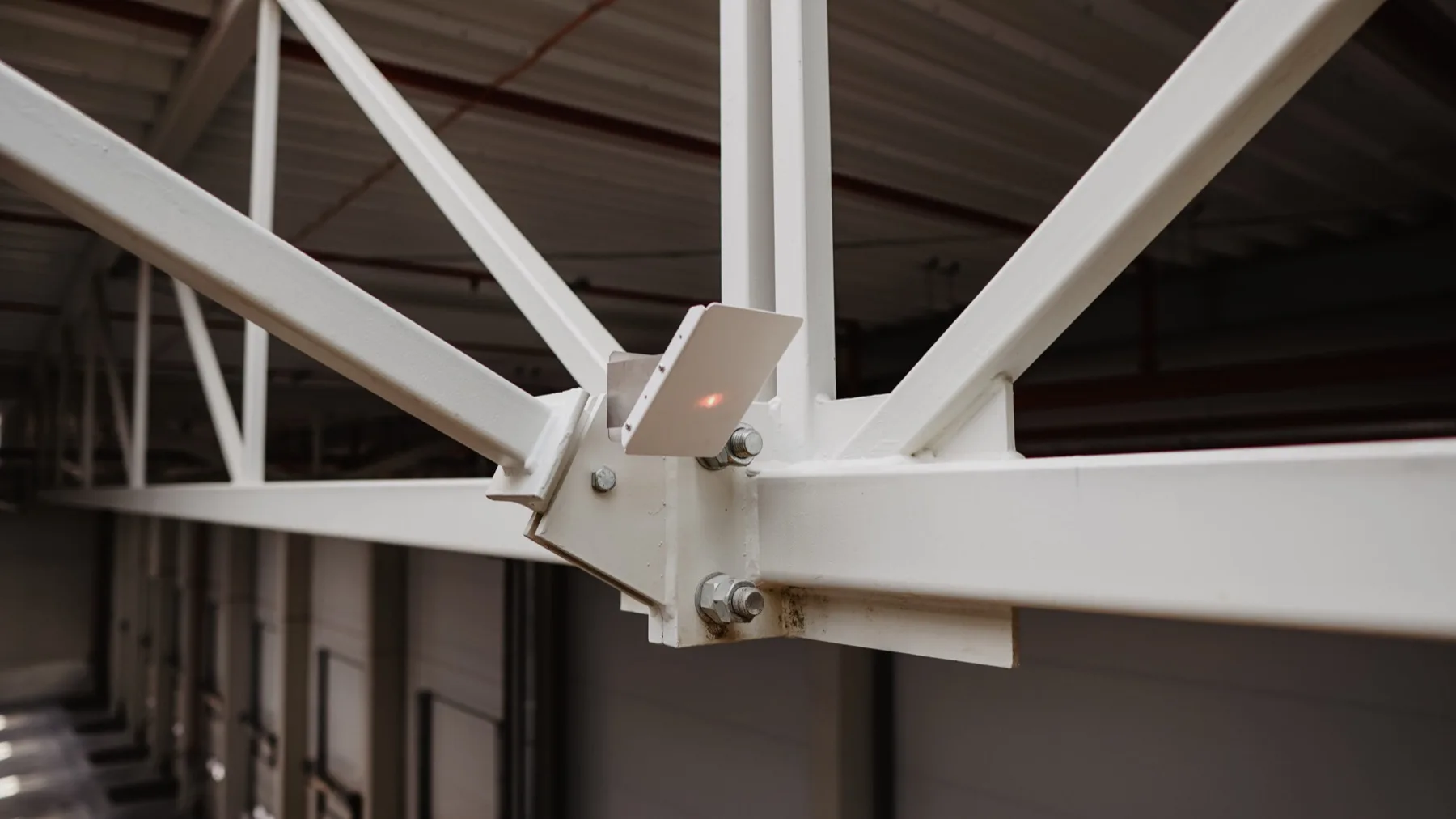
A certified installer mounts the system under the roof. Each S-One laser sensor is fixed at a support point and aimed at a target board at mid-span, so it does not interfere with use of the floor.
DSW sensors are wireless and solar powered, and they install without cutting into the roof. One gateway per building connects to mains power. Sense engineers train and certify every installer and supervise each partner’s first installation.
- 3
Commissioning
Installer partner and Sense
The sensors start reporting to the Smart Roofs Platform. We set the alert levels for each measuring point from the allowable deflection in the construction design, confirmed with the building’s designer.
Your team gets training on the platform and a user guide that covers every key feature.
From then on
- 4
24/7 monitoring and alerts
Smart Roofs Platform, for your site team
S-One measures deflection every 3 minutes with 0.04 in (1 mm) accuracy. DSW measures the water level every 60 seconds, and as often as every 20 seconds in intense rain, with accuracy up to 0.2 in (5 mm).
When a reading crosses a level, your site team gets an alert by SMS, email and app. Weather Alerts compare forecasts with your building’s design parameters and warn you ahead of severe weather.
- 5
Service
Installer partner, backed by Sense
Your installer is your local contact for service on site. Most issues are resolved remotely, without any action from you. Behind every partner, Sense provides documentation, remote diagnostics and a direct line to our engineers for complex cases.
The laser sensors have a minimum service life of 10 years, and the system comes with a 24-month manufacturer’s warranty.
What happens when a reading crosses a level
Alert levels are a share of the allowable deflection in your roof’s construction design: Level 1 at 50%, Level 2 at 70% and the design limit at 100%.
52% measured peak
- 100% Design limit
- 80% Start snow removal
- 70% Level 2 alert
- 50% Level 1 alert
- 1
Your site team gets an alert
The platform sends an SMS, an email and an app notification. Each message gives the current reading and a link to confirm it has been read.
- 2
They check the building in the platform
The interactive map shows the status of every building on one screen, with charts for each measuring point, on the web or in the mobile app.
- 3
You decide what to do
Each building follows its own response procedure. Sense recommends starting snow removal at 80% of the allowable limit, allowing for the crew’s mobilization time and the weather forecast. Weather Alerts add 48-hour and 7-day forecasts.
Installed and serviced by certified partners in North America
Partners
Sense works with certified installer partners: companies with experience in commercial roofing or building maintenance, trained and certified by Sense engineers.
Each partner covers its own territory, so the company that installs your system is also your contact for service. Roofing and building maintenance companies can join the program, with training, certification and engineering support from Sense.
Questions before you start
Anything else? Email [email protected] or use the contact form.
How long does installation take?
From a few hours to a few days, depending on the size of the building and how the system is set up. For example, installing 10 sensors in a 107,600 sq ft (10,000 m²) building typically takes 2–3 days.
How are the sensors installed?
Under the roof. Each S-One laser sensor is mounted at the support point of the member it measures, for example on a column. Its target board goes where the deflection is greatest, typically at the mid-span of a girder or purlin.
Who decides where the sensors go?
Our structural engineers. They analyze the building’s structural design documentation and choose the number and position of the measuring points for the parts of the roof that matter most. For existing buildings, we also talk to the people who use the building about its history. On some projects, the building’s structural designer sets the locations.
Who sets the alert levels?
The allowable roof deflection is usually given in the construction design. When we set up the system, we always confirm the allowable values with the building’s designer. If the building has no documentation, a structural assessment comes first. Alerts go out at 50%, 70% and 100% of the allowable limit.
How long do the sensors last, and what is the warranty?
The laser sensors have a minimum service life of 10 years. The system comes with a 24-month manufacturer’s warranty.
What happens if something stops working?
S-One runs at 99.99% uptime, and most issues are resolved remotely without any action from you. If a site visit is needed, your installer partner is your local contact for service, backed by Sense engineers.